> For the complete documentation index, see [llms.txt](https://academy.synap.ac/doc/llms.txt). Markdown versions of documentation pages are available by appending `.md` to page URLs; this page is available as [Markdown](https://academy.synap.ac/doc/users-and-groups/creating-groups.md).
# Creating groups
How to create new groups, set a type and add / invite users.
Creating groups and adding users is an essential part of managing your Synap platform. In general, your user groups will closely align with the content on the platform. For example, you might have a 'Summer Econ 101 Exam Group' with users sitting that exam and the exam assigned to the group.
Users can be members of more than one group, and you may have some groups purely for management purposes. For example, an 'ACME Company User Group' could be used just to manage users from that company. Users take the highest level of permissions from the groups they are in. If a user is in both a student group and an educator group, they will be an educator. You cannot create new Admin or Manager groups.
{% hint style="info" %}
🧠 On Synap it is membership of a group which determines what someone has access to (with the exception of direct enrollment exams).
{% endhint %}
To create a new group, go to the **Users** page and click **Create group**.

### 🧑🎓 Student groups
To make a new student group, give the group a name, set the user type, add a description, and set a sub portal if needed.
Creating a new student group
We recommend giving your groups an easily identifiable short name that shows other users exactly who is in the group.
{% hint style="info" %}
🧠 Remember **students cannot see** the names or descriptions of the groups they are in!
{% endhint %}
New empty student group
Once your group has been created, you can add existing users or invite new ones. See our guide on adding and inviting users for more.
{% content-ref url="/pages/5mlW46Br0j5pIgPNtROU" %}
[Adding & inviting users](/doc/users-and-groups/creating-groups/adding-and-inviting-users.md)
{% endcontent-ref %}
Edit a group's name and description at any time. You cannot change the group user type or sub portal once it has been created.
Go to a student group's **Settings > Access** page to configure specific educator groups to view, edit, or modify learning records according to your requirements.
### 🧑🏫 Educator groups
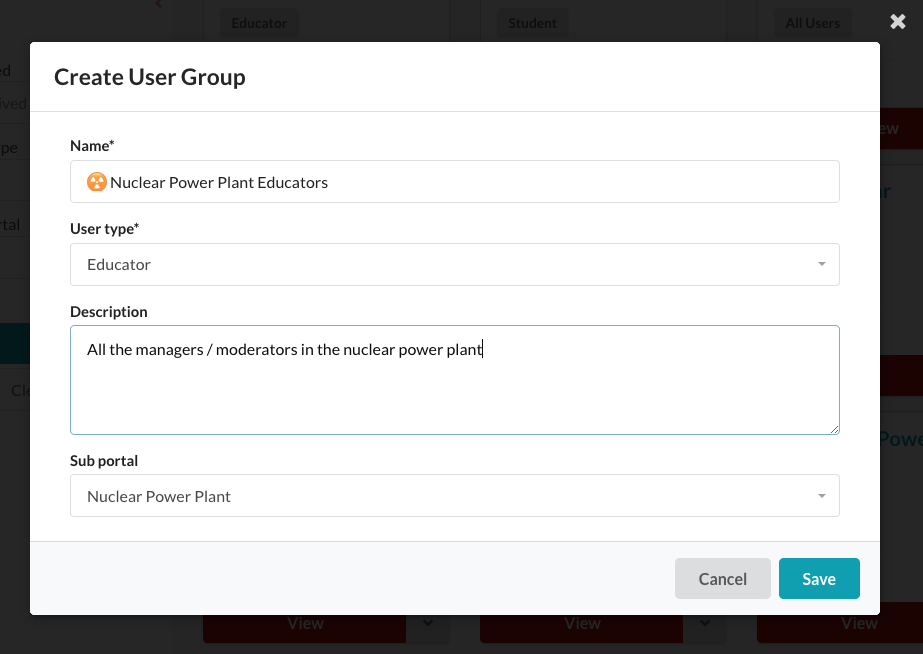
Follow the same steps above to create an educator group. Just make sure you set the user type to `Educator`.
Making an educator group
Educators are the most configurable role on Synap. Go to a group's **Settings > Permissions** page to set global permissions for the group.
Global educator permissions
There are many different roles you can create with global and specific permissions. See our permissions guide below for more information.
{% content-ref url="/pages/tFz72HQbklA8DSVmZoXu" %}
[Permissions](/doc/users-and-groups/permissions.md)
{% endcontent-ref %}
### 💡 Top tips
The user group ID, sub portal, type, and description are shown below the name in the top-left corner. You can click this once to copy it to your clipboard, then use it when searching for a user group to assign an exam to or grant access to a collection.
User group names
{% embed url="" %}
---
# Agent Instructions
This documentation is published with GitBook. GitBook is the documentation platform designed so that both humans and AI agents can read, navigate, and reason over technical content effectively. Learn more at gitbook.com.
## Querying This Documentation
If you need additional information that is not directly available in this page, you can query the documentation by asking a question.
Perform an HTTP GET request on the following URL with the `ask` and `goal` query parameters:
```
GET https://academy.synap.ac/doc/users-and-groups/creating-groups.md?ask=&goal=
```
`ask` is the immediate question: it should be specific, self-contained, and written in natural language.
`goal` is what the user is ultimately trying to achieve, the reason they need the answer. Sharing it helps GitBook give you a better, more relevant answer. A goal is most helpful when it describes the outcome the user wants rather than restating the question. For example, with `ask=how do I create an API token`, a goal like `automate deployments from our CI pipeline` lets GitBook tailor the answer to that use case.
The response will contain a direct answer to the question and relevant excerpts and sources from the documentation.
Use this mechanism when the answer is not explicitly present in the current page, you need clarification or additional context, or you want to retrieve related documentation sections.